In Praise of Whitespace
7/16/2026
6 minutes readPhoto by Erdem Bircan
In Praise of Whitespace
7/16/2026
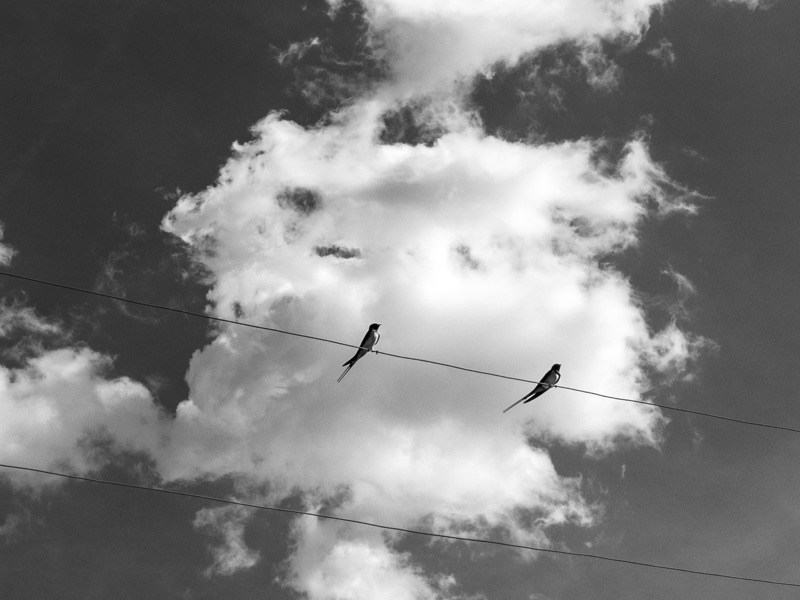
6 minutes readTwo swallows on a power line. That is the entire inventory of the photograph at the top of this post: two birds, two wires, one cloud doing most of the work. I took it on the street, with a digital camera, which means I have since examined it through tools whose whole purpose is to help me improve it. Their most persistent suggestion has always been the same. Crop it. Get closer. The subject is small, the frame is nearly empty, fix that.
Cropped in, this is a mediocre photograph of two birds. You would scroll past it in a field guide. Everything the picture has, it has because of what surrounds the birds: the gray weight of the sky, the white mass of cloud they perch against, the two diagonals slicing the emptiness into directions. The photograph is not of two swallows. It is of the room around them, and the swallows are what keeps that room from being nothing.
Photographers call this negative space, and it is among the first things the craft teaches you. Not as a flourish for advanced students, but as a foundation: the subject does not carry the frame, the space around the subject does. I shoot black and white, which makes the lesson impossible to avoid. Black and white photography is an act of removal before it is anything else. You take away color, the loudest channel in the image, so that structure, light, and geometry can speak. The removal is the art.
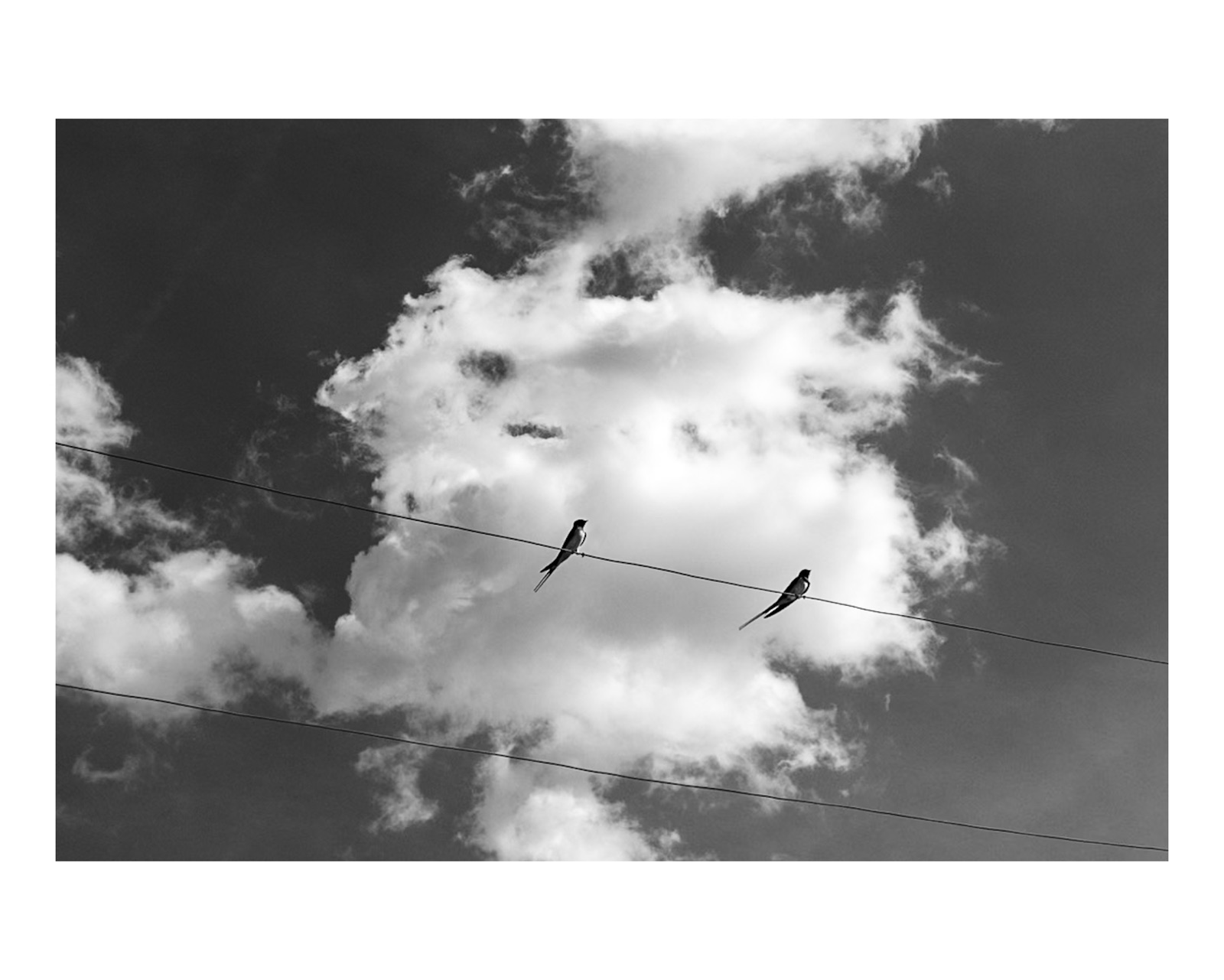
The cover above had to be cropped to fit its slot, which is its own small irony for this particular post. Here is the frame as it actually prints, borders and all:
Look Again
Look at the frame once more, and this time forget photography.
Ninety percent void. A few thin lines running through it. Two small dark glyphs sitting on a line, placed exactly where they mean something.
You have seen this layout every working day of your life. It is a source file.
Two Crafts
I split my time between two crafts. One of them taught me, early and permanently, that emptiness is material: you compose with it, you balance it, you protect it from your own urge to fill it. The other craft calls emptiness "whitespace," argues about it endlessly, and then deletes all of it in a build step.
I keep crossing between these two rooms, and the contradiction does not wear off. In the photography room, nobody has ever had to convince me that the void carries meaning. It is in the curriculum. It is in every critique. Leave the sky in. Let the subject breathe. What you exclude is a decision, and what you leave empty is a bigger one. In the code room, the same person who kept that sky spends his days in a culture that has fought a fifty-year war over invisible characters while insisting, in the same breath, that they do not matter. Tabs versus spaces has outlived several programming paradigms. Python made indentation load-bearing in 1991, and half the industry has still not forgiven it. We have strong opinions about nothing, and no theory to hang them on.
Everyone Else Has a Theory of Nothing
Every mature craft I can think of has formalized its emptiness.
Sculpture had it first. The block of marble contains the figure, Michelangelo is supposed to have said, and the sculptor's job is to remove the stone that is not the statue. The material that leaves the studio floor is the work, precisely as much as the material that remains.
Music wrote its emptiness directly into the notation. A rest is not the absence of music; it is music you are instructed not to play, with a duration, a position, and a symbol of its own. Ask any musician where the groove lives and they will tell you: in the space between the notes.
Japanese aesthetics built an entire vocabulary around it. Ma, the interval, the pause, the empty room that makes the full room legible. Tanizaki wrote In Praise of Shadows in 1933 to defend darkness itself against the arriving floodlights, an essay-length argument that what the light does not reach is where the meaning pools. This post steals half of his title because the debt is real.
And then there is code. Code has style guides. Style guides are theories of visual composition that refuse to admit it. Every argument about line length, blank lines, alignment, and indentation is art criticism conducted by people who deny that art is involved. We are the only craft culture I know that reads its own negative space fluently and still insists it is not there.
The Grades of Blank
Ansel Adams built the zone system on the observation that black is not one thing. Zone 0 is a black with no detail; Zone I is a black that is barely not that. A photographer who cannot tell them apart prints mud. Darkness has grades, and learning to see them is the craft.
Code's emptiness has grades too, and every working programmer reads them without being taught. The blank line between two functions is a paragraph break. The indentation at the start of a line is structure, drawn entirely in nothing. The aligned column of values in a config file is a table whose borders are made of space. The single gap after a comma is punctuation's shadow. Each of these is a different kind of blank, carrying different information, and we parse all of them before we read a single token. You recognize a pyramid of nested callbacks by its silhouette from across the room, long before you can read the code. That is not syntax. That is composition.
We have a zone system. We just never wrote it down, so we argue about it one linter rule at a time.
The Tool Asks
Digital photography made keeping the sky harder, not easier. On film, the frame was the frame; cropping meant an enlarger, an easel, and a reason. Now the crop is one gesture, free, reversible, and quietly suggested. The tool practically asks. Every empty region of every frame now survives on conviction alone, because nothing in the workflow defends it.
Code went through the same transition and drew the opposite conclusion. There was a time when the emptiness in code genuinely cost something: bytes were scarce, wires were slow, and stripping whitespace was housekeeping with a receipt. That time ended. Compression made whitespace essentially free in transit; a gzipped file barely notices whether the source was minified at all. And yet the ritual survives. We still run a build step whose principal job is to delete every space the author placed, not because the economics demand it, but because the belief outlived its justification.
Here is the cleanest way I can put the difference. The photographer removes to reveal. The minifier removes because it believes nothing is there. Same verb, opposite faiths.
Figure, Ground
Gestalt psychology calls it figure-ground: the vase and the two faces, and the flip where the background becomes the subject. Photography plays with that reversal on purpose. Code, as far as I knew, never did. So recently I tried it, in the most literal way I could think of: a terminal game whose playing field is its own source code, laid out as justified text, where the snake you steer is not drawn with characters at all. It is a channel of pure whitespace pushing the words apart. The ground, promoted to protagonist. It is an experiment, and it sets out to prove nothing. But steering a piece of emptiness through a page of working code does something odd to you after a few minutes: the text stops being the content, and the gap becomes the thing you care about. The frame flips, and it does not fully flip back.
The Sky You Keep
Crop the photograph at the top of this post down to its subject and you get a field-guide entry: two swallows, adequately documented, instantly forgettable. The picture was never the birds. It was the decision to keep everything around them.
I do not think code is different. The blank line you place between two thoughts, the indentation that lets a reader see the shape of your logic before parsing a word of it, the column of aligned values that turns a wall of assignments into a table: that is the sky in your source file. It costs nothing to keep and it is the first thing our tooling deletes, silently, on the way out the door.
We spent fifty years arguing about invisible characters. That was never a waste of time. It was the closest thing our craft has to art criticism, and the argument was always about the same thing the photograph is about: whether the empty part is part of the work.
It is. Keep the sky in.