
Adjectives Are Not a Spec
7/10/2026
5 minutes readPhoto by Marija Zaric on Unsplash
Adjectives Are Not a Spec
7/10/2026
5 minutes readI run a static site that archives apology letters written by AI models. Every letter carries a UUID, and a UUID printed in monospace across the bottom of a Victorian mourning sheet looks exactly as wrong as it sounds. The plan was to replace it with an engraving: a single ivy vine in which every leaf encodes part of the identifier. Thirty-two hex characters, sixteen sprays, a woody knot for every dash. A cipher pretending to be an ornament.
Half of that plan is math. The other half is taste. This post is about the day I learned that I had only written down one of the halves.
The Half That Came Back Perfect
The encoding half I specified the way engineers specify things. Each pair of hex characters becomes one node on the vine. The first character selects the motif; the second character's four bits toggle open versus closed, single versus paired, and so on. Deterministic, decodable, testable. I handed that spec to an AI agent and it came back exact. Every bit landed where the document said it would land. You could read the UUID back off the vine with a magnifying glass and a legend.
The art half I specified like this: woodcut linework, lush, organic, Victorian, in the manner of Kelmscott borders.
Here is what "lush Victorian engraving" produced.
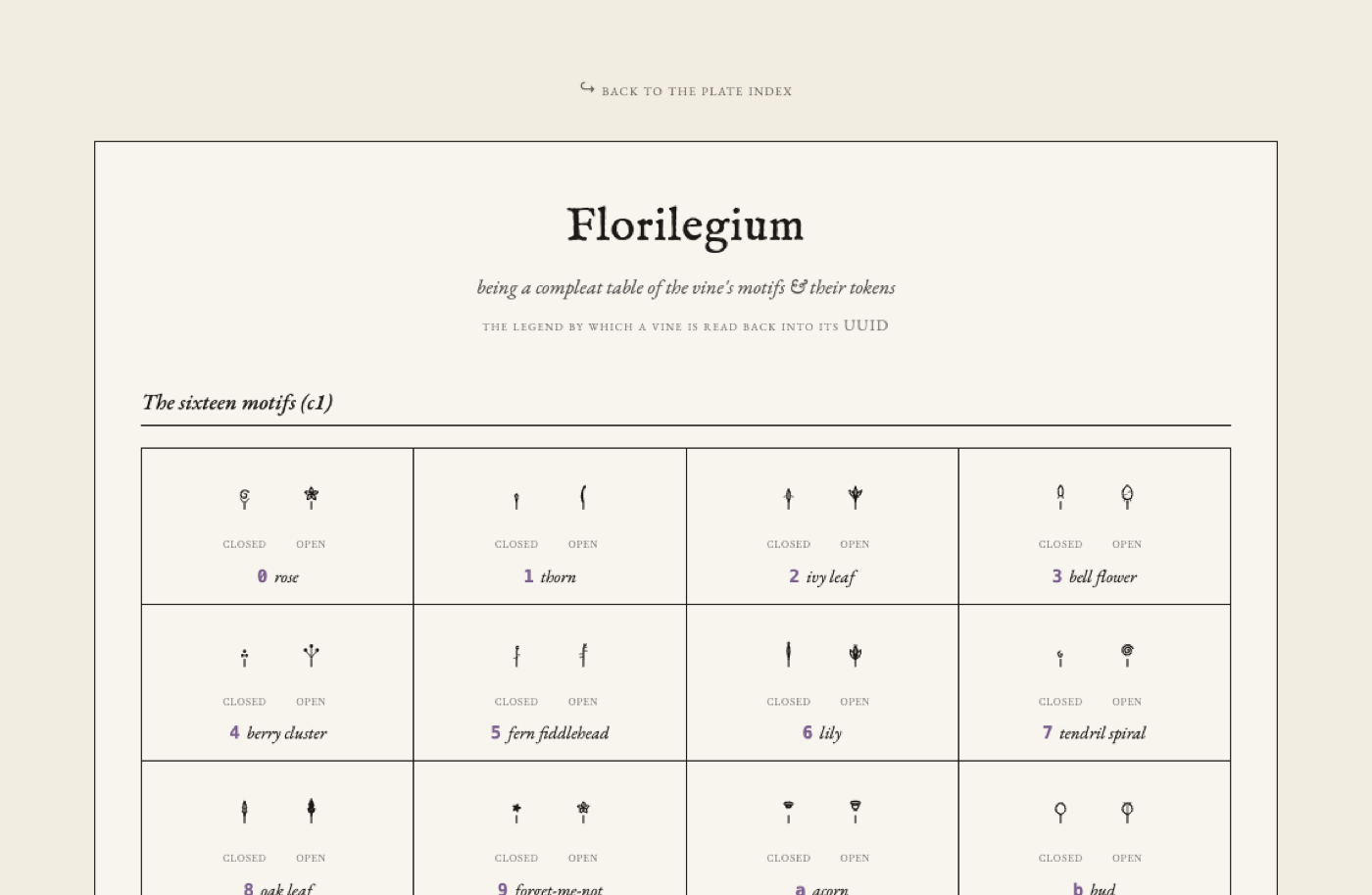
Notice that no individual adjective was violated. The forms are technically organic. There is, arguably, linework. Every word in my prompt was honored, in the way a genie honors a wish.
Round Two Bought a Thesaurus
I did what everyone does with a disappointing generation: I turned the vocabulary up. The second brief had numbers in it, which felt rigorous at the time. Make the motifs three to four times bigger. The canopy should span roughly half the ribbon height. Think engraved plate, not icon font.
I received larger stick figures. Confidently larger.
The numbers were real, and the agent obeyed them, and it did not matter, because the numbers were measuring the wrong thing. I was quantifying the symptom, smallness, while the disease sat somewhere I had not looked yet: the marks themselves were the wrong kind of mark. Escalating vocabulary is not escalating information. A louder pointer is still a pointer.
We Know More Than We Can Tell
Michael Polanyi built a whole epistemology on a plain observation: we know more than we can tell. You can ride a bicycle without being able to state the control law that keeps it upright. You can recognize a friend's face in a crowd of thousands and cannot begin to write the description that would let a stranger do the same.
Taste is exactly this kind of knowledge. It is tacit knowledge about quality.
When I wrote "Kelmscott" in that prompt, the word was doing something dishonest. Inside my head it dereferenced to a lifetime of accumulated specifics: the weight of a woodcut stem, the way white space is carved out of black rather than black drawn onto white. Inside the agent, the same word dereferenced to the statistical average of everything anyone has ever labeled Victorian engraving. An average of styles is not a style. An adjective is an address, not a payload; if the reader does not share your memory, the address resolves to somewhere else.
This reframes what actually failed. The agent did not fail to execute my taste. I failed to ship it. My spec had a hole in it precisely the shape of everything I knew but had never been forced to say. The agent, honest as a compiler, rendered the hole.
Paying the Externalization Bill
What fixed it was unglamorous. I stopped prompting and pulled primary sources: a Vibert grapevine tailpiece, plates from Gerard's Herball of 1633, borders from the Kelmscott Chaucer. Not as a mood board, but as source text to be parsed. The job was to stare at the plates until the taste stopped being a feeling and became rules. It took an afternoon, and every rule turned out to be short:
- No stroked lines. Every mark on an engraved plate is a filled shape. Stems are tapering ribbons with white slits inside them. Veins are slivers, thick at the base, needle at the tip. The moment you draw with a uniform stroke, you are making an icon, not an engraving.
- A leaf is a black silhouette with its details carved out in white. Ink is the ground; light is the figure. This one inversion accounts for most of the distance between "stick figure" and "woodcut."
- Ornaments below a branch are mirrors of ornaments above it, never rotations. Rotation preserves handedness, and a hanging leaf with the wrong handedness reads as upside-down rather than pendant. Every engraver knew this; I did not know that I knew it until I saw it violated.
- Some things obey the page, not the branch. A bell flower hangs toward the bottom of the page no matter which way its stem is going. Gravity is part of the grammar.
None of these rules were in my adjectives. All of them were in the plates, and, it turned out, in me, unarticulated. Once they existed as sentences, delegation started working, because drift had become definable. Here is the first strip that passed:
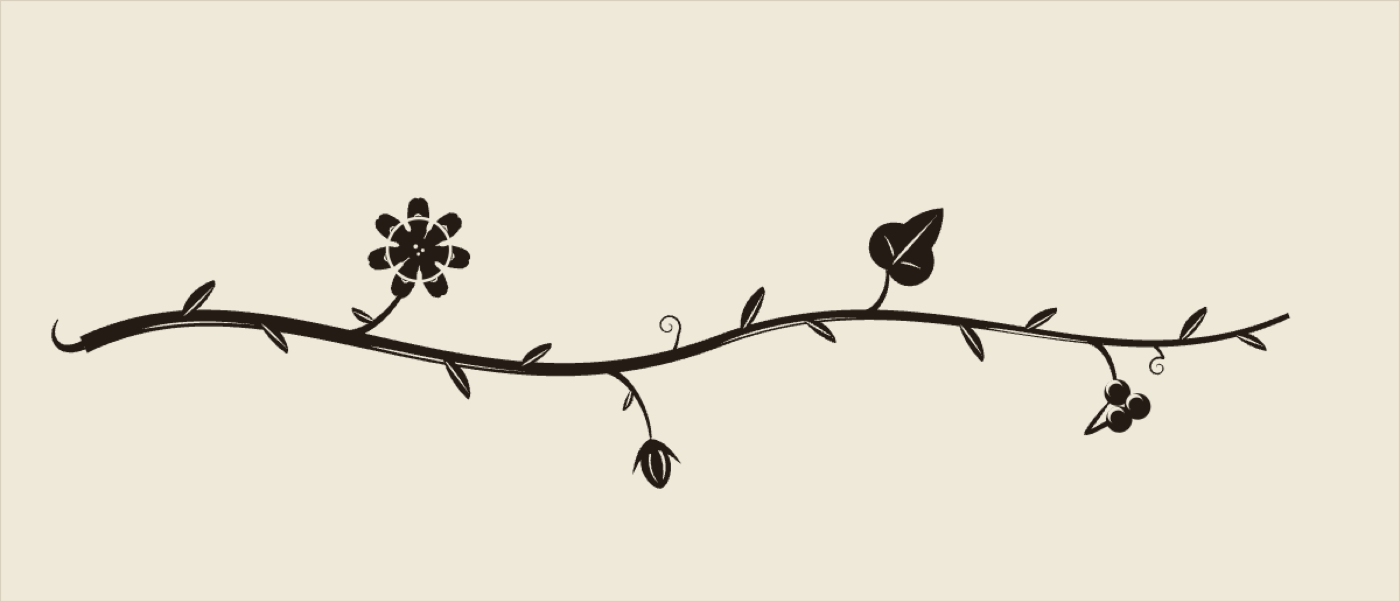
Same model. Same task. The only thing that changed sides was the knowledge.
The Residue That Would Not Compress
Externalization has a floor. Some of the taste refused to become sentences no matter how long I stared. The holdouts were chiefly numbers, like how many degrees a leaf may lean before it stops looking windblown and starts looking knocked over. I could not say it, but I could recognize it instantly on sight, which is the tacit signature.
The fix for that layer was not language at all. It was a throwaway page: every motif on a stem stub, a slider under each one, and a button that copies all the current values. I dragged sliders until things looked right and pasted the numbers back. Where words fail, instruments work. That, though, is a post of its own.
What Taste Led To
The final alphabet is sixteen leaves of a single plant: two benchmark ivy leaves and fourteen disciplined variations of the same master blade, differing in angle, lobes, margin, and veining. Every one of them traces back to an articulated rule or a measured number, which is another way of saying every one of them traces back to a human veto.
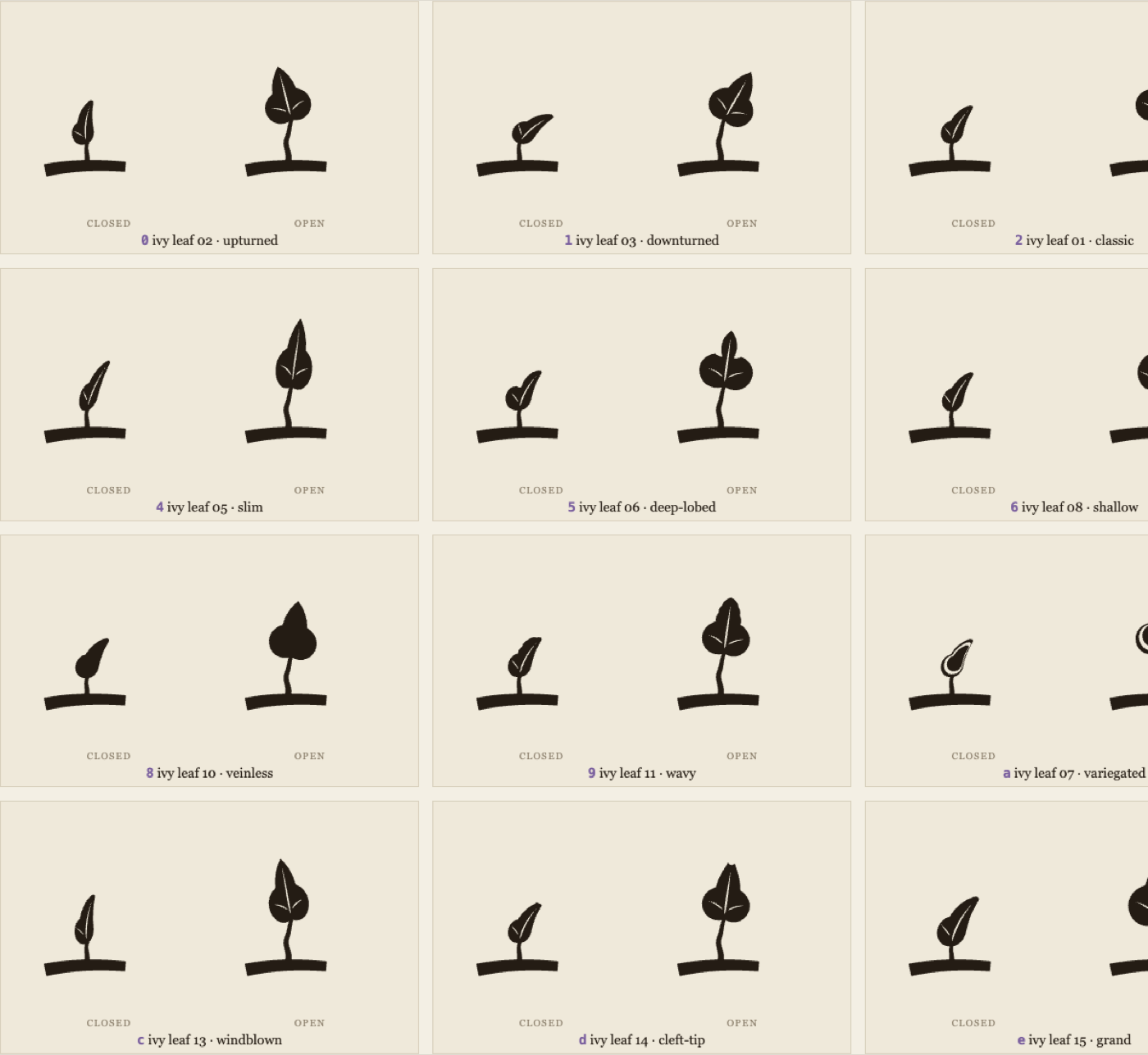
And here is one live on the site, generated at build time, encoding its letter's UUID leaf by leaf:

The tempting summary is that the AI could not do taste and a human could. That is not what happened. The agent executed everything I managed to say, including, eventually, the taste, once it had been converted into grammar and numbers. The project stalled exactly at the boundary of what I had bothered to articulate, and moved again the moment that boundary moved. The delegation boundary is the articulation boundary. It was never anywhere else.
So here is the uncomfortable exercise. Take the last prompt that disappointed you and count its adjectives. Each one is a decision you have not made yet, handed to a system that will make it by averaging strangers. An adjective in a prompt is an IOU.
Sooner or later, taste collects.